
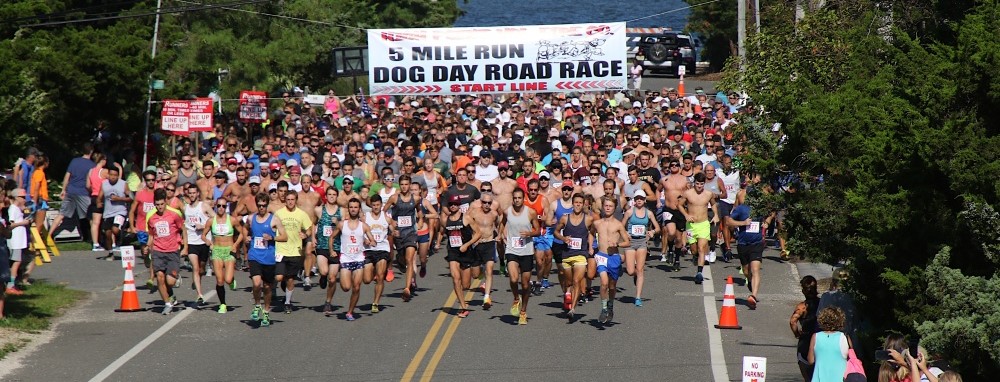
The race originated in 1979 as a community fundraiser to
support the all-volunteer fire company. The idea for the event came from an
avid runner who competed in races throughout the East Coast. This fire company member believed that the
novelty of a 5K race in the heat of August at the Jersey Shore would appeal to
serious runners, especially marathoners preparing for the fall racing season. At
first there was resistance for the event from local officials, but fire company
members rallied behind the idea and eventually got the green light.
The name itself, "Dog Day", is a nod to the Sirius star (the "Dog Star") whose rising coincides with the hottest days of summer, hence the saying “The Dog Days of Summer”. Running a 5-mile race in August heat has become a badge of honor for participants, many of whom return year after year.
The early visual identity of the race — the hand-painted signs, artwork, and logos that gave the event its character — was the work of a part-time college student working for the Harvey Cedars public works department that summer. That creative contribution helped establish the look and feel of the race.
The early years had its quirks. The course was not permitted to cross the borough line into North Beach, so the route wound through Maiden Lane, looped the circle, and snaked through back streets and alleys off Essex and Bible Conference Road to reach the 5-mile distance. And at the first finish line? … kegs of beer. The 5-mile racecourse continues to be solely in Harvey Cedars with water stations along the course route manned by local volunteers.
From the first race and up until 2012, registration was handled entirely on paper, with runners signing up by hand and race organizers managing entries manually. Over time, this process evolved, and today registration is conducted fully online, making participation easier and more accessible for runners from near and far.
Race timing has undergone a similar transformation. Early races relied on handheld stopwatches and volunteers recording finish times, collecting bib tags at the finish line to match runners with their results. As the race grew, so did the need for greater accuracy and efficiency. The event now uses electronic chip timing and modern finish-line systems, allowing for precise, real-time results.
What began as a scrappy, community-run fundraiser with
roughly 100 runners on August 26, 1979, has grown into one of Long Beach
Island's signature summer events. The race now surpasses 1,000 runners — a
testament to years of community loyalty, volunteer dedication, and the enduring
spirit of the original idea.
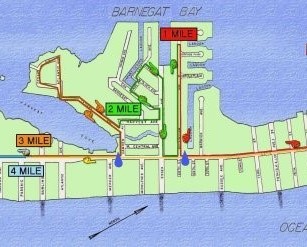
Click on map for full race course
Course starts on West 80th Street at the Fire House and loops through Harvey Cedars with the finish line back at the Fire House.
PO Box 3219
Harvey Cedars, NJ 08008